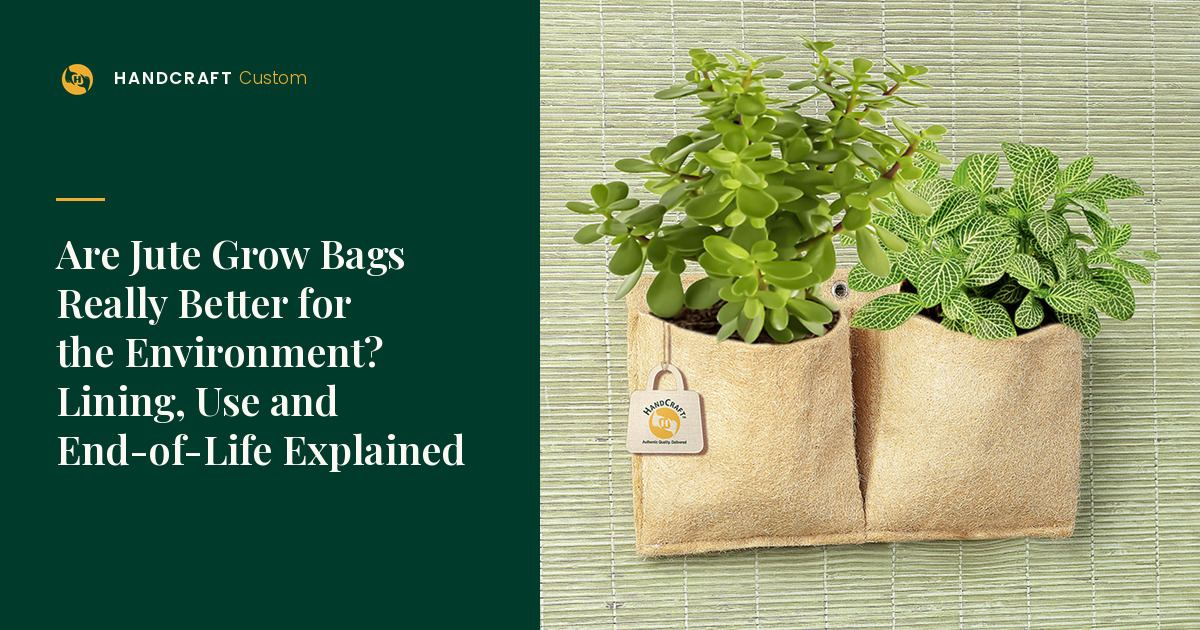
Are Jute Grow Bags Really Better for the Environment? Lining, Use and End-of-Life Explained
Jute grow bags are often presented as an obvious environmental win. For an organisation planning a garden project, CSR planting drive or education programme, the honest answer is more useful: it depends on how the specific bag is made, how long it serves, and what happens to it afterwards. Here is how to assess that before you buy or make any public statement.
This article is about environmental assessment. Choosing between indoor planters, outdoor grow bags and wall-hanging formats is covered in the planter and grow-bag format guide.
Start with the whole product, not the fibre
Jute is a natural plant fibre. That is a fact about the fibre, not a conclusion about the finished grow bag. The bag may also include stitching thread, a liner, a printed panel, handles or a backing. Each component affects how the bag behaves in use and at end of life.
- Unlined natural fabric: breathable, and at end of life the fabric may suit organic-waste routes where these exist locally. It is also more exposed to wet soil and weather, so service life outdoors can be short.
- Lined construction: a liner can hold soil and moisture better and extend useful life, but if the liner is plastic the bag is no longer a single-material natural product. The liner then needs separate disposal.
- Printed panels: HANDCRAFT uses azo-free inks. Azo-free is a specific chemistry statement; it does not by itself make a product organic, compostable or food-safe.
Ask for the actual construction of the grow bag you are quoting, including whether a liner is present and what it is made of, before writing any environmental description.

Service life changes the comparison
A grow bag that lasts one season and a container that serves for several years are not equal comparisons. Outdoor exposure, watering frequency, sunlight, humidity and soil contact all shorten the life of natural fabric. Rather than assuming a lifespan, agree with your project team how long the bags need to serve: one planting cycle, a school term or a longer installation. Then choose construction to match.
End-of-life depends on local systems
“Biodegradable” describes what a material can do in suitable conditions. Whether that happens depends on the receiving system. Before claiming the bags can be composted, check:
- Whether participants have access to composting or organic-waste collection
- Whether any liner, tag or trim must be removed first
- Whether printed areas are acceptable to the local facility
What you can say about jute grow bags and the environment
Keep public wording proportionate and specific. “Grow bags made from natural jute fabric” is a description. “Plastic-free”, “zero waste” or “improves soil” are claims that need evidence for the exact product and use. For the wider method of assessing any jute bag, see Is a Jute Bag Really Eco-Friendly?
Questions to include in your enquiry
- Is the grow bag lined? If so, with what material?
- What thread, handles or tags are attached?
- Which sizes are available in the Outdoor Jute Grow Bags range?
- Is printing required, and on which panel?
- What service period does the programme need?
Questions buyers ask
Does an unlined jute grow bag decompose in soil?
Natural fibre breaks down under suitable conditions, but rate and completeness depend on use and local conditions. Do not publish a timeframe without evidence.
Which planter format suits our project?
See choosing between indoor, outdoor and wall-hanging formats. For whole-product environmental assessment, see is a jute bag really eco-friendly?.
Planning a planting drive or education garden? Describe the intended use, lining preference, size and quantity through the Bulk Enquiry route, and HANDCRAFT will confirm the construction and quote individually.